
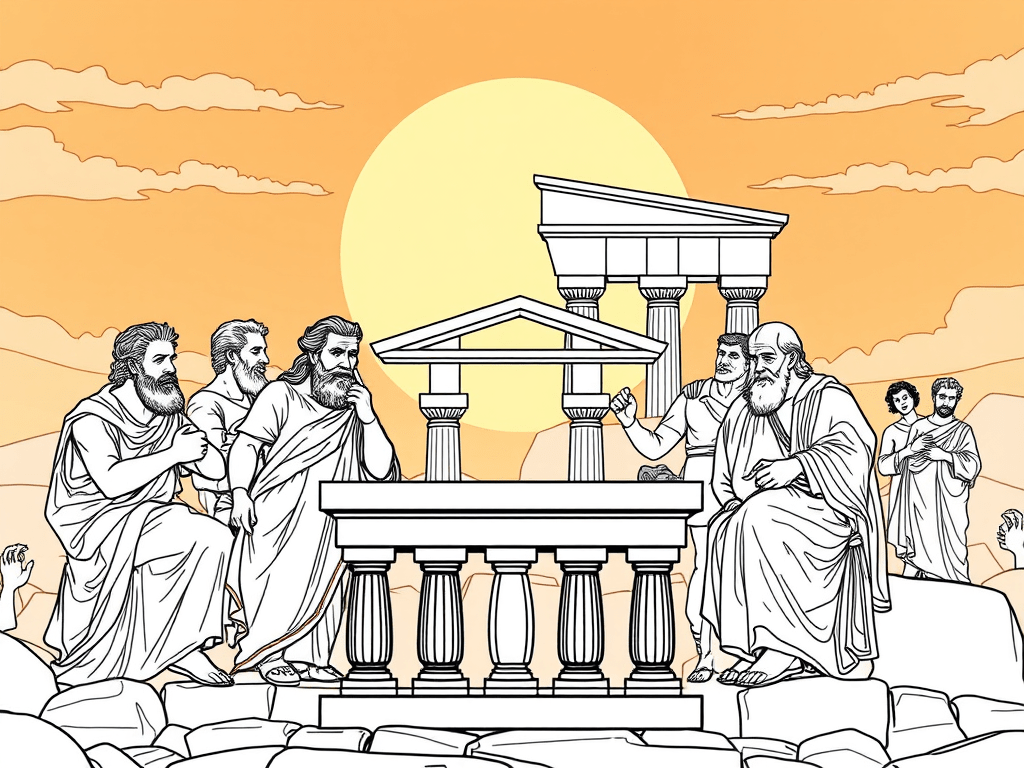
We all find ourselves in these places—the places of endless debate. You know, the ones where nothing truly significant gets accomplished, yet people act as if they have everything figured out.
That is precisely where we find ourselves in this passage: the Areopagus, a gathering place akin to a city council. By the time Paul arrived, it had become a meeting ground for philosophers—thinkers who spent their days discussing and debating ideas.
Among them were two main groups:
The Epicureans—They believed everything happened by chance, death was the end of all things, and the gods were distant, uninvolved, and indifferent. Their highest aim was pleasure.
The Stoics—They believed that everything was divine, that all events were governed by fate, and that history endlessly repeated itself in cycles of destruction and renewal.
These were the intellectual elite, the place to hear the most exciting ideas about the world and how to live in it. They prided themselves on their wisdom—yet they had no way of making “the other side” agree with them.
The Problem with False Religion
This situation reveals something crucial: intellect alone has never eliminated false religion. These people were worshipping what they liked, building altars to their desires and fears alike.
The truth is, we do the same today. We worship—meaning we give excessive time, attention, and resources—to the things and people that bring us pleasure. At the same time, we also worship what we fear, doing anything to keep uncertainty and hardship at bay.
Then, Paul enters the scene, and the Holy Spirit begins to move.
Paul’s Calling and Mission
Remember Paul’s calling in Acts 9:
“But the Lord said to Ananias, ‘Go! This man is my chosen instrument to proclaim my name to the Gentiles and their kings and to the people of Israel. I will show him how much he must suffer for my name.’”
Paul was handpicked by God to proclaim the Gospel to the Gentiles and their rulers. Despite beatings, imprisonments, and slander, Paul remained steadfast in his mission.
As he walked through Athens, he was deeply distressed by what he saw—altars everywhere, each one dedicated to a different god. The people were desperate to cover all their bases, ensuring their lives remained easy and their gods appeased.
The Altar to the Unknown God
As Paul searched the city, even entering the Temple of Athena, one altar caught his eye—an altar to an unknown god. This intrigued him. The Athenians thought they had accounted for every deity, but just in case they had missed one, they erected this altar as a safeguard.
It may seem strange, but is it really so different from what we do today?
Modern Idolatry
Walking through a Walmart, I see idols and gods everywhere—things tempting and enticing people to pour their money, time, and devotion into them.
- The god of Tylenol—offering relief at any cost.
- The god of Coca-Cola—promising comfort in a bottle.
- The god of Blue Bell—demanding indulgence.
- The god of entertainment and fashion—shaping identities.
- The god of food—consuming rather than nourishing.
And in the midst of all this, I see images of the God—yet no one is paying attention.
The same is true at football stadiums:
- The god of the end zone.
- The god of children’s success.
- The god of “Football is life.”
People pour their money, energy, and passion into these things, while the Spirit grieves that so few acknowledge the true God.
But most troubling of all, I see this in the church:
- The god of music.
- The god of carpet color.
- The god of furniture placement.
- The god of status symbols.
- The god of the preacher’s sermon.
Worship becomes centered on personal preferences rather than surrendering to the living God.
Why Do We Worship These Things?
Because they are controllable. We like gods that we can manipulate, place where we want them, and make them serve our desires. We crave control, even in our faith.
Even as Christians, we fall into this trap. We say we trust God, yet we cling to control, forcing things to happen in our own way and timing. If things don’t go as planned, we blame others, circumstances, or even God Himself.
What Causes You Distress?
The Holy Spirit is constantly at work, opening our eyes to what should distress us. But often, our frustrations are misplaced:
- The plane didn’t arrive on time.
- The restaurant got our order wrong.
- Someone took our parking spot.
- Our team lost the game.
We pour our emotions into these trivial matters, yet when it comes to worship and serving Christ, we are emotionally drained. We have conditioned ourselves to watch worship rather than participate in it.
Think about the way we speak:
- “My football team.”
- “My baseball team.”
- But when it comes to church? “The preacher’s sermon,” “The music that day.”
We subtly shift our focus away from worshiping God to making worship about us.
The Athenians and the Unknown God
The Athenians weren’t opposed to adding new gods, but they had rules:
- The sponsor must claim to represent a deity.
- The sponsor must provide evidence that the deity is willing to reside in Athens.
- The deity’s presence must benefit Athenian life.
Paul met these conditions:
Verses 22-23 – He established himself as a proper herald of Jesus.
Verses 24-29 – He declared that the living God is not confined to temples or religious rituals.
Verses 30-31 – He proclaimed that Jesus seeks the lost, calls for repentance, and has been resurrected—offering hope rather than fear.
As Paul spoke, many Athenians were intrigued and began to follow him, eager to learn more about Jesus Christ.
Our Call Today
We find ourselves in the same position as Paul. We walk through:
- Walmart.
- Grocery stores.
- Movie theaters.
- Sports fields.
- Churches.
And everywhere, we see people worshipping lesser gods. They may not realize it, but they carry symbols of the God—the cross, a representation of Christ—without truly knowing Him.
Even as believers, we sometimes miss the opportunity to know God personally. But the Holy Spirit offers us a fresh wind and fire. We are called to proclaim with boldness, joy, and courage that Jesus Christ is Risen!
This is not just a remembrance of what He did. It is a call to live in the reality that He lives.
Will We Be Bold?
Are we strong enough in Christ to do what He asks? Not everyone will receive the message of Jesus, but we remain steadfast, partnering with the Holy Spirit as we go into the world.
People came to faith because Paul was obedient to the Spirit’s call.
May we be just as bold in our faith—proclaiming Christ, encountering Him, and inviting the world to truly know the unknown God.
BEGINNING QUESTIONS:
What are your thoughts about this scripture/sermon?
What are you looking forward to as we begin this journey through Acts?
What might the Spirit be speaking to you as you begin this journey through the book of Acts?
How to work through this study of Acts
Each week begins with a sermon or reflection on the week’s scripture, written by Ryan, to help guide your thoughts and deepen your understanding. These sermons serve as starting points for discussion and reflection on the passage.
You are also encouraged to explore the discussion questions that follow each sermon. While the questions remain the same each week, your answers and conversations will evolve as you engage with the scripture in new ways.Additionally, there is a companion resource titled Transformation 1:8, located in the appendix. This discipleship challenge book is designed to help you explore what it means to live as a disciple of Christ in today’s world. I encourage you to take the time to engage with this resource and discover how it can transform both your personal faith and your communal walk with Christ.

 R Y A N S T R A T T O N